Character reference sheets
Every chapter picture is generated against these, so a character looks like themselves from one chapter to the next.

Manny Breezy · Ollie Anvil · Vanna Bloom · Uncle Ocean · Valerie Starqueen · Swole Tully · Orion Hunt · Mandy Moodkiller

Melvin · McEvilface

Mason · Free Trial Nate · Sigmauron

Based Ben · Lucy Slay · Goodest Boy · Baddest Boy

Finn Senior · Finn · Fightin' Finley · Finny Sensible · Clutch Finnegan · Max Onehand · Freestyle Finrod · Queen Gigi

Tragic Tim · Hugh Chair · Stone-Cold Morgan · Nina No-Memory

Gaslight Gary · Skaiju · Moggy the Goth · Fire Bouncer · OG Werewolf · Hungy Ungy

Lentil Tallboy · Izzy Yoink · Sunny Ari · Pharaoh Chad · Gilbert Glowstick · Spaceboat Eddie · Ellie Birdwife
How the art was made
None of the art on this site was drawn by hand. Every picture in the book, including the reference sheets above, was generated with openai/gpt-image-2.5-sunburst through OpenRouter, then re-encoded to PNG and WebP pairs. The superseded versions further down this page are the exception: some of them came off the model this one replaced, and that gallery is where the two are put side by side.
Each picture is generated from the reference sheets, 3 of the book’s own pictures as style references, a written description of everyone in the scene, and this shared style prompt. The words “hand-drawn” below are an instruction telling the model what to imitate — they are not a description of how these pictures were made:
A single sheet of lined loose-leaf notebook paper, punched holes down the LEFT edge, red margin rule. Ballpoint and felt-tip pen over pencil, filled in with COLOURED PENCIL. Drawn by a talented but UNTRAINED thirteen-year-old who is really into manga, going all-in in the margins of a workbook.
13 chapters carry a second picture partway down the page. Those are older: same model, but an earlier version of the same prompt, kept because they show a different moment than the picture at the top of the page.
The pictures that move
Every chapter picture has a little motion in it. The still is what loads; the animation is fetched afterwards and faded in over the top of it, and it is never shown to anyone whose system asks for reduced motion.
Each one is the still picture above handed to alibaba/wan-3.0 through OpenRouter as its first frame, and the clip is let run instead of being pinned back to where it started. Pinning both ends closes the loop perfectly and costs the motion: the cheapest way to finish where you began is to barely move. So the loop restarts on a cut you can see, and the gesture gets to finish. This is what is asked of it, plus one line per chapter naming what should move:
Static locked-off camera. No zoom, no pan, no parallax. The drawing stays flat on the page. Animate this as clean hand-drawn animation. The ink and coloured-pencil lines stay stable: they must NOT boil, shimmer or re-sketch themselves. This is a drawing whose figures move, not a drawing being redrawn. Keep the scribbled coloured-pencil texture and the hatching exactly as they are - do not smooth, clean up or polish the drawing as it moves. Give this ONE clear beat of action, and commit to it. What is named below should be unmistakably moving - a gesture that carries through and finishes, not a twitch. Everything NOT named holds still. … The lined notebook paper, the page edges, the punch holes, every handwritten label and every caption stay exactly as drawn. Do not write anything. No new word, name, label, letter or number may appear anywhere on the page - the only text is the text already drawn, and it stays exactly as drawn. No new objects, no camera movement, no 3D depth, no photorealism.
And a list of things to keep out:
smooth interpolation, cinematic camera, dolly, parallax, 3D render, photoreal, realistic lighting, depth of field, morphing text, garbled lettering, new lettering, watermark, extra fingers
How the music was made
The soundtrack exists twice, and the chapter plays both at once. The live take is a score rather than a recording: it is written out by hand in music.js, synthesized in your browser on the way past, and it never performs the same way twice — the chords, the terraforming underneath and the moments Melvin decides to interrupt are all chosen as it plays. Nothing about it was generated.
Underneath it sits a recorded take of the same brief, generated with google/lyria-3-pro-preview through OpenRouter, with google/lyria-3-clip-preview for the thirty-second destruction clip. This is the brief it was given, written as a brief to a choir rather than as a list of settings:
Wordless sacred choral music, interrupted twice by Mongolian throat singing. Two things alternate; nothing else happens. THE CHOIR: an Eastern European Orthodox church choir of adults singing vocalise on 'oo' and 'ah'. No words, no lyrics, no language of any kind. The key is D minor and it never changes. The bass drone is a low D at 73 Hz, held from the first second to the last, and every chord sits on top of it. B-flat, never B natural. Close harmony in D minor over that drone (the ison), Slavic and Bulgarian in colour, with a Phrygian-dominant cadence and a flat-second chord leaning on the tonic from a semitone above. Basso profondo men underneath, women in close harmony above. Adults only: no boys' choir, no soloist, no vibrato-heavy opera voices. A large stone church with long natural reverb and no modern production. Slow, reverent, enormous, unhurried. Underneath them, quietly, the sound of a world being built: distant tectonic rumble, a sub-bass groan sliding downward, rock grinding against rock, a single struck anvil ringing in the same key, steam venting. Scenery, never louder than the voices. No drums, no beat, no percussion, no synthesizers, no strings, no orchestra. THE INTERRUPTION: one man alone, throat singing in the Mongolian style. Kargyraa - a very low growling drone around 70 to 100 Hz with an octave-below subharmonic rasp under it, and a piercing whistled overtone melody far above. When it happens the choir stops completely: no voices, no harmony, no rumble, nothing but the one throat singer alone in the empty reverb of the church. It is rude, and it lasts. Follow this structure exactly: [0:00 - 0:45] Choir alone, swelling slowly on 'oo' over the bass drone, tectonic rumble far beneath them. [0:45 - 1:05] THE CHOIR STOPS DEAD. Twenty full seconds of the throat singer alone: growling low drone and whistling overtones, no choir at all, no rumble, one voice in a big empty room. [1:05 - 1:40] The choir creeps back in on a strange new chord, a semitone rub that was not there before, and slowly rebuilds the harmony around it. [1:40 - 2:00] THE CHOIR STOPS DEAD AGAIN. The throat singer alone a second time, louder and more insistent than before. [2:00 - 2:45] The choir returns in full harmony, and this time the throat drone stays underneath them instead of over them. The terraforming swells with it. [2:45 - 3:00] Everything cuts off at once. Silence. Do not modulate. Do not change key. The piece begins and ends on D minor.
Lyria will not be told what key to sing in. The brief above says D minor three times and the take came back in E minor anyway. Rather than re-rolling it until it complied, the chapter declares the key its recording landed in and the live score transposes to meet it — chords, drone, anvil, Melvin and the chord names in the caption all move together, so the two performances agree.
Every layer on its own
The live take never plays twice the same way, so there is nothing to link to or quote unless one performance is pinned to a file. These are one such performance, rendered from seed 20260918: the finished mix, each synthesized layer alone, and the recordings that sit underneath them. They line up with each other because they are all the same take.
- The Theme of the Choir Kids the mix
Everything at once, as the page plays it. - The live choir synthesized
Synthesized voices and the bass drone, in the browser. - The live terraforming synthesized
Synthesized geology: tectonics, grinding, anvils, steam. - Melvin synthesized
The synthesized throat singing that interrupts everyone. - The recorded choir recorded
Lyria's take on the same brief. - The recorded world recorded
Earth sliding, water pooling, wind, forests unfolding. - The recorded ruin recorded
Volcanoes, landslides, thunder, wolves. Follows an interruption.
What the art looked like before
The chapter 02 picture on this site is the fifth version of itself, and the four before it were not kept: each regeneration overwrote the last in place, so the only copy of each is the file in the commit that replaced it. These are read back out of those commits and resized for this page — the pictures that were on the site, not reconstructions of them — and each is labelled with the commit it came from, so a claim made here can be checked against the change that made it.
Chapter two was the control image throughout. It is the one the diagnosis was done on - the original was put beside each regeneration to work out what was wrong - so it is the one chapter with a picture from every stage.
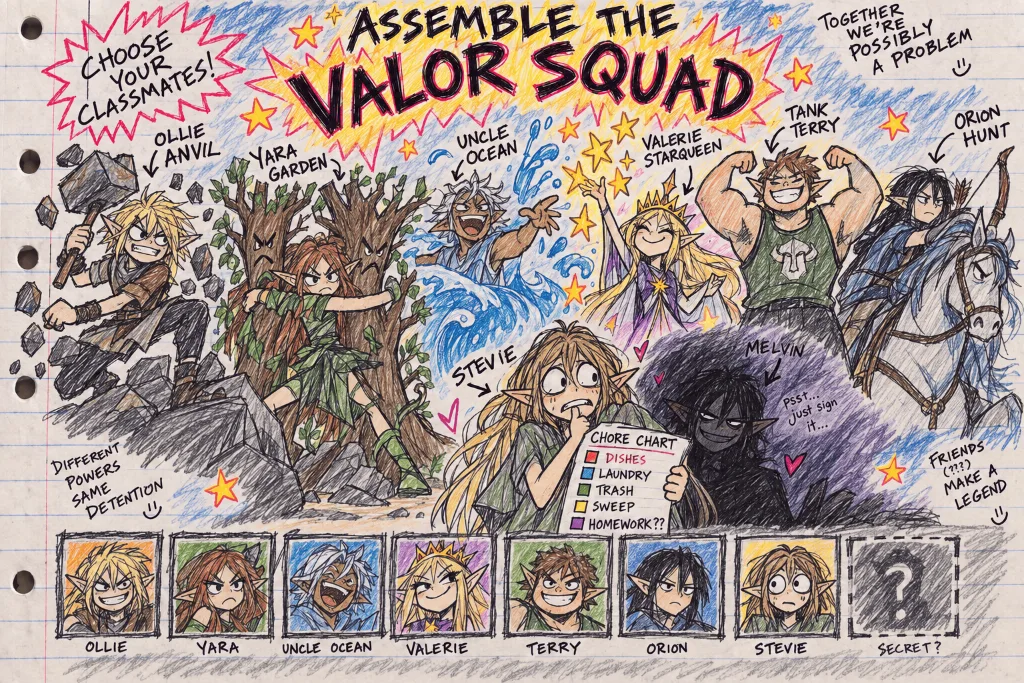
e8b0081The original art, and the thing every later attempt was measured against. Its prompt was never written down anywhere in this repository: all that survives of it is one sentence of direction in the README, 28 words long, with no rules and no negations. Everything below is an attempt to get back to a picture nobody kept the recipe for. Names inked onto this one — Yara Garden, Tank Terry, Stevie — are joke names the book has since dropped. Renaming reaches text and never pixels, so a retired name stays in a picture until the picture does.
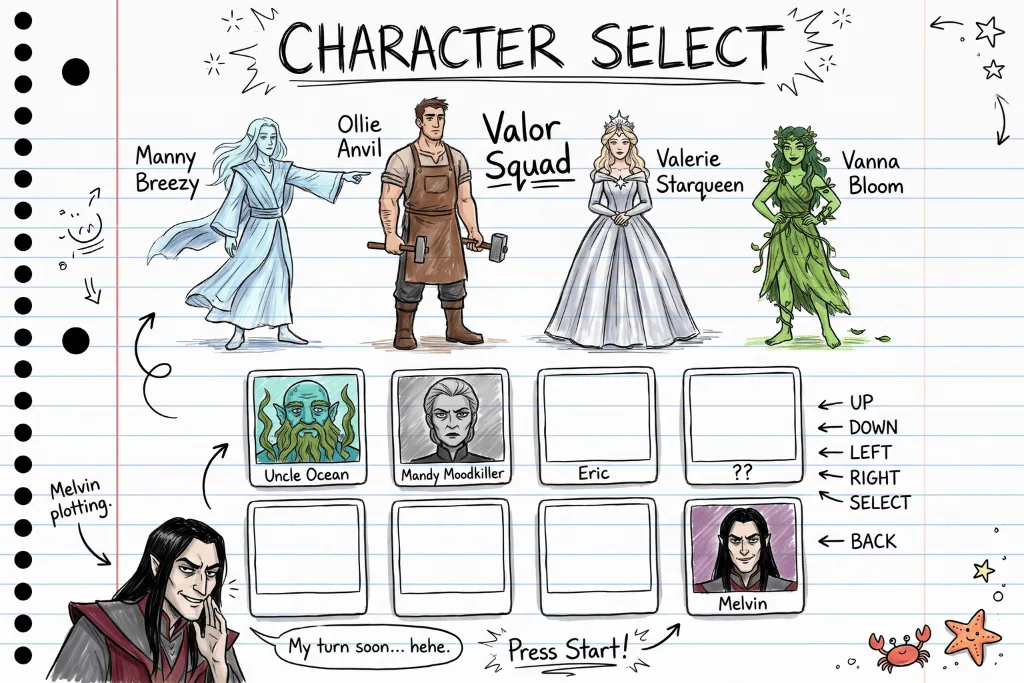
e2dfb70The first regeneration against the new reference sheets. The sheets fixed the designs and then kept going: the render copied their composition too, and the chapter came back as a character-select screen - figures evenly spaced in a row, facing front, standing still, most of the page empty. The sheets show people lined up against bare paper because that is what a reference sheet is for, and nothing had told the model that this was not also what a chapter should look like.
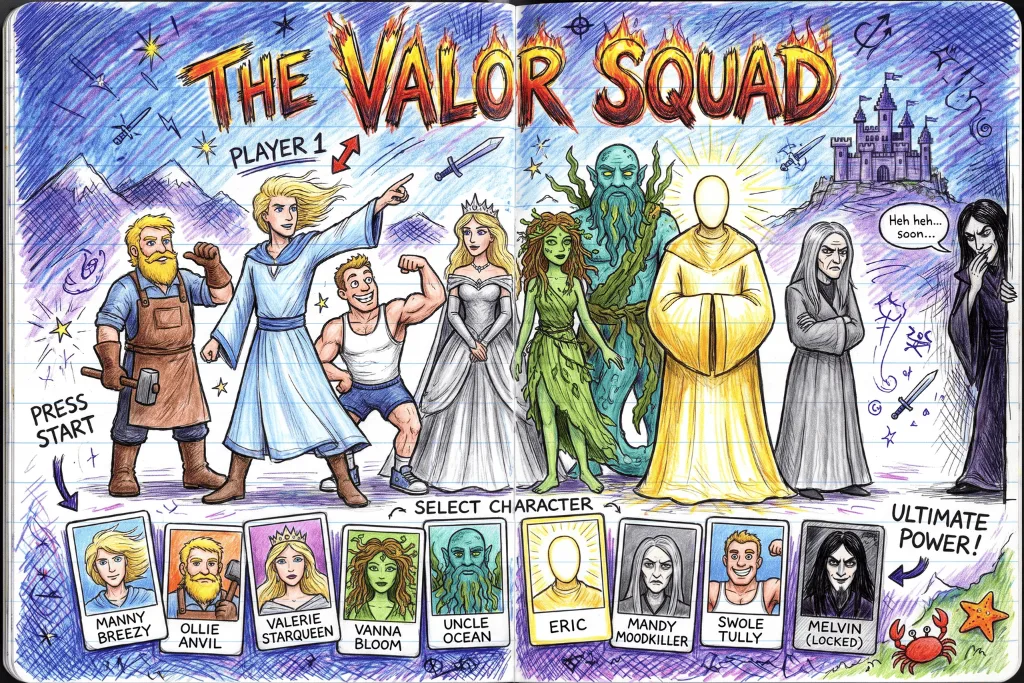
dcf7704Fixed by scoping the sheets explicitly: they are for appearance only - face, hair, skin, ears, build, costume - and never for layout. A chapter is a scene, with characters mid-action, overlapping, at different sizes, some cut off by the frame; fill the page, crosshatch the background to the edges, pile on the marginalia. The composition came back. The rendering did not: the faces are still symmetrical and softly shaded, and the colour is still blended smoothly rather than scribbled on.
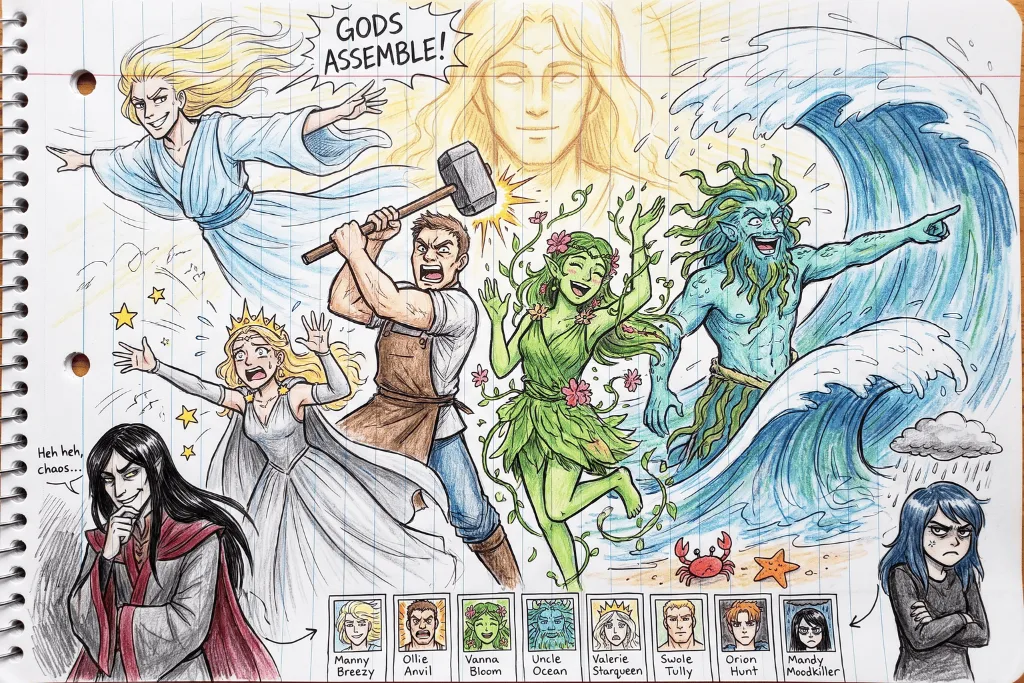
21f7cdePutting the original beside the regenerations made the remaining tell specific, and it was never composition: it was faces and colour. The original has exaggerated cartoon faces - big white eyes, huge grins, gritted teeth, eyebrows doing all the work, maybe ten strokes each - with colour scribbled in flat so the strokes show and bare paper shows through. Rules for that went into every prompt, and they had to say they applied to the dignified characters too, because a serene king was being read as an exception and quietly given a portrait face. Closer. Still cleaner and more evenly coloured than the thing it is imitating.
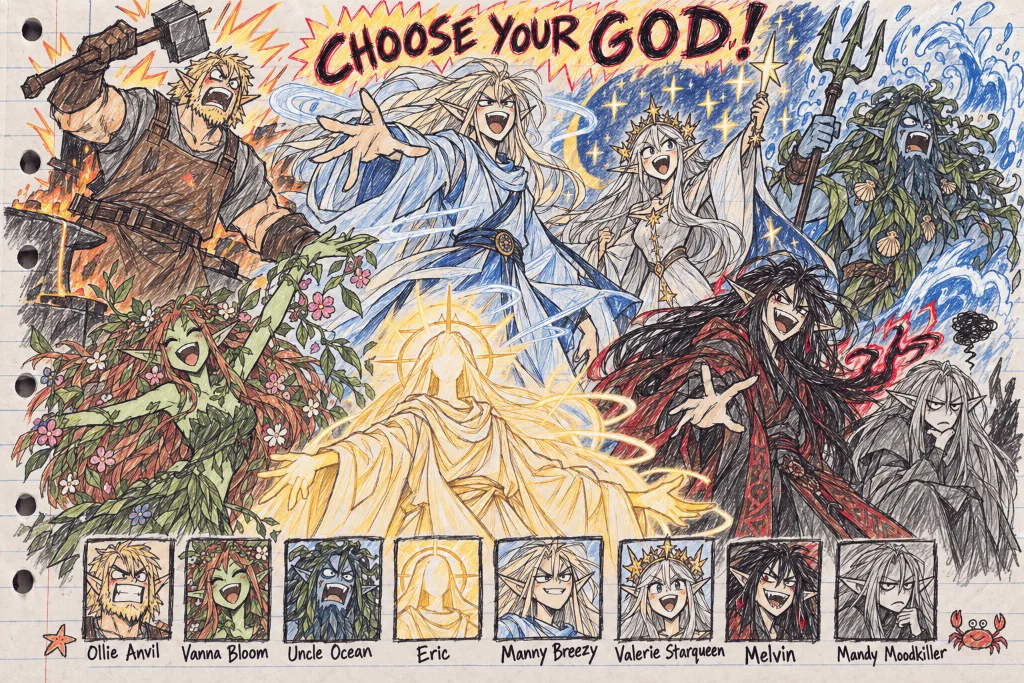
952a8c0Two things changed at once here, so neither can be credited alone: the model changed, and the prompt was cut from 1,336 words to 648 - 31 rules to 17, 84 shouted words to 20, 29 negations to 10. Most of that rule stack existed to argue the previous model out of drawing polished realistic portraits, and once the model changed, the argument was not needed; leaving it in was pushing the render toward satisfying a checklist. What the prompt kept is what was still load-bearing, and 484 of the remaining 648 words are the per-character appearance notes, which are the part measurably doing work: they are what stopped Uncle Ocean turning into a naval officer.
One variable at a time
The model was isolated on the reference sheets rather than on a chapter, which is why this pair is the evidence and the one above it is not. Identical prompt, identical reference images, one variable changed.
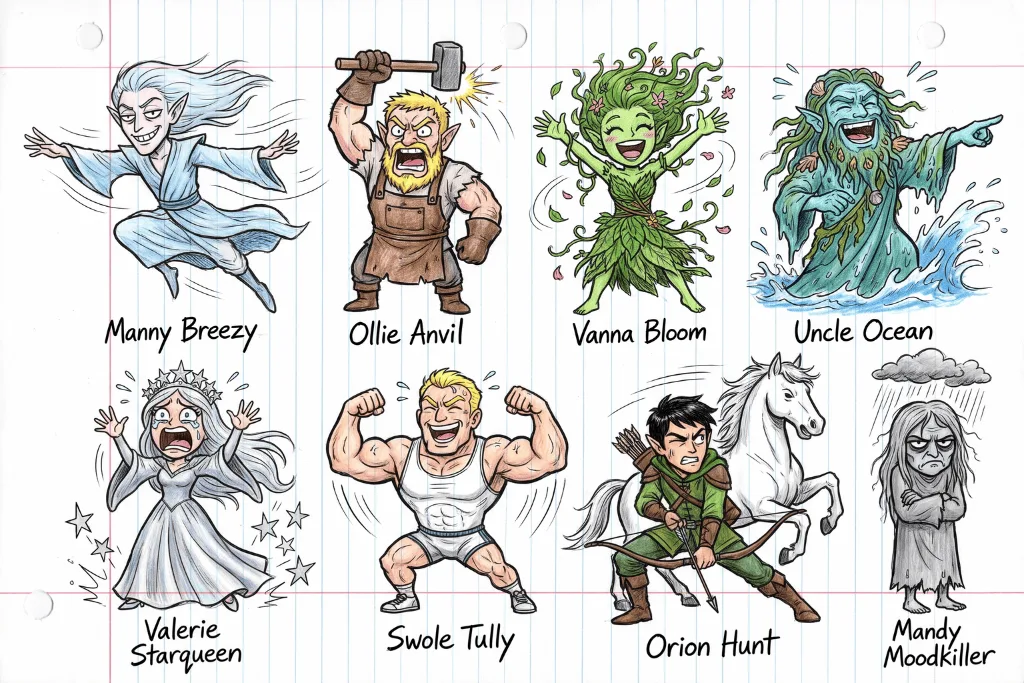
21f7cdeClean outlines, smoothly blended digital colour, figures floating on white. Five rounds of prompt rewriting had got the faces cartoonish and could not get the surface to stop looking printed.
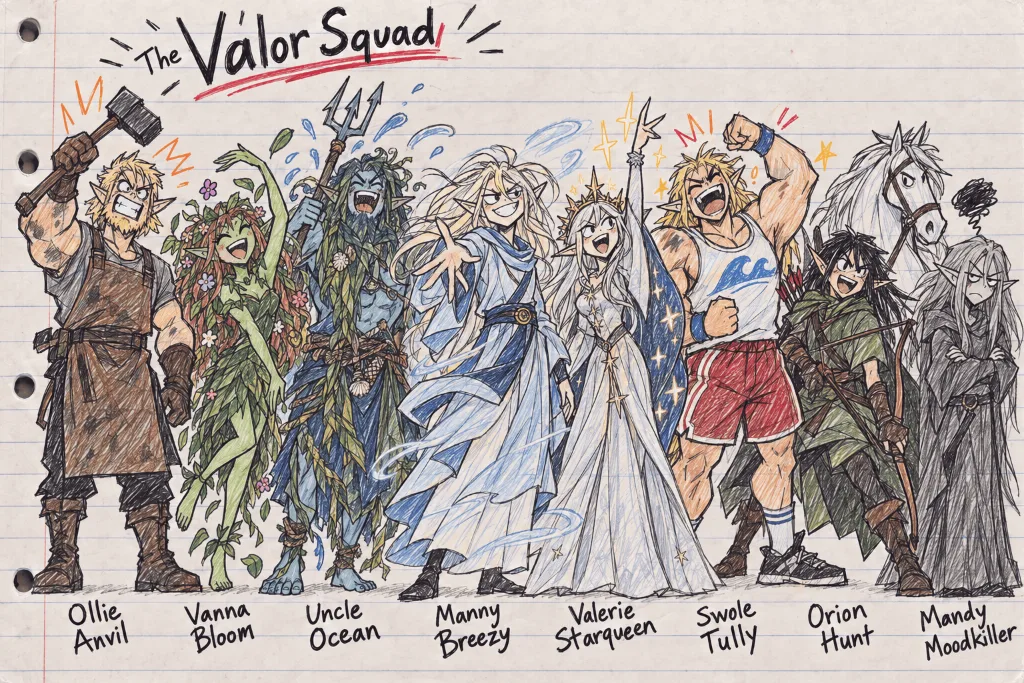
c2941dfThe same prompt, the same references, a different model: individual coloured-pencil strokes, heavy uneven ink, colour overshooting the outlines, the whole group crowded onto a sheet of lined paper. Prompt length was tested directly and was not the lever - a 127-word version composed better and lost the look entirely. The prior belonged to the model, not to the instructions.
Meme templates
Slot text is positioned over the art as real text rather than baked into the image, so it stays selectable and readable by a screen reader. Each template is used at most once in the book.
- Drake Hotline Bling — Hotline Bling (2015), Drake - music video screencap
- Two Buttons — 'Daily Struggle' - webcomic panel by Jake Clark (jake-clark.tumblr.com)
- Expanding Brain — 'Expanding Brain' - composite macro, origin unattributed
- Gru's Plan — Despicable Me (2010), Illumination - screencaps
- This Is Fine — 'On Fire' (2013), KC Green - webcomic panels
- Trade Offer — 'Trade Offer' TikTok format - stock footage
- Clown Applying Makeup — 'Clown Applying Makeup' - composite macro, origin unattributed
- Woman Yelling at a Cat — The Real Housewives of Beverly Hills screencap composited with 'Smudge the Cat' stock photo
Maps
The nine maps in the appendix are drawn for this book, by openai/gpt-image-2.5-sunburst — the same model as the chapter art, in the pen-and-ink appendix style. None of them is Tolkien’s own map: the estate’s maps are in copyright, none is reproduced and none was used as a reference image.
What they were drawn from is a written description of the layout, one per map, in maps.json. Those descriptions were read off nine freely licensed maps at Wikimedia Commons. Nothing of theirs is served from here — the files sit in the repository as sources, the way the lore summaries below do — and the licences do not reach a picture drawn from a description. They are named anyway, because the appendix would not exist without them:
- The Ages of the Lamps — after Ian Alexander, CC BY-SA 4.0 (File:Arda in the Ages of the Lamps.svg)
- The Years of the Trees — after Ian Alexander, CC BY-SA 4.0 (File:Arda in the Years of the Trees.svg)
- Arda in the First Age — after Ian Alexander, Public domain (File:Arda in the First Age.svg)
- Beleriand — after Chiswick Chap, CC BY-SA 4.0 (File:Sketch Map of Beleriand.svg)
- Tragic Tim's tour of Beleriand — after Chiswick Chap, CC BY-SA 4.0 (File:Turin Turambar locations in Beleriand.svg)
- Arda in the Second Age — after Ian Alexander, CC BY-SA 4.0 (File:Arda in Second Age.svg)
- Númenor — after Ian Alexander, CC BY-SA 4.0 (File:Númenor Sketch Map.svg)
- The Downfall of Númenor — after Ian Alexander, CC BY-SA 4.0 (File:Downfall of Númenor.svg)
- Middle-earth at the end of the Third Age — after Ian Alexander, CC BY-SA 4.0 (File:Sketch Map of Middle-earth.svg)


Lore sources
The factual layer under the jokes comes from Silmarillion Writers' Guild chapter summaries by Dawn Felagund, read for every chapter before it was written.
The text
Written for this book. No original Tolkien text is reproduced here, and none is bundled with it. The names are jokes; tap one anywhere in the book to see the real one.